
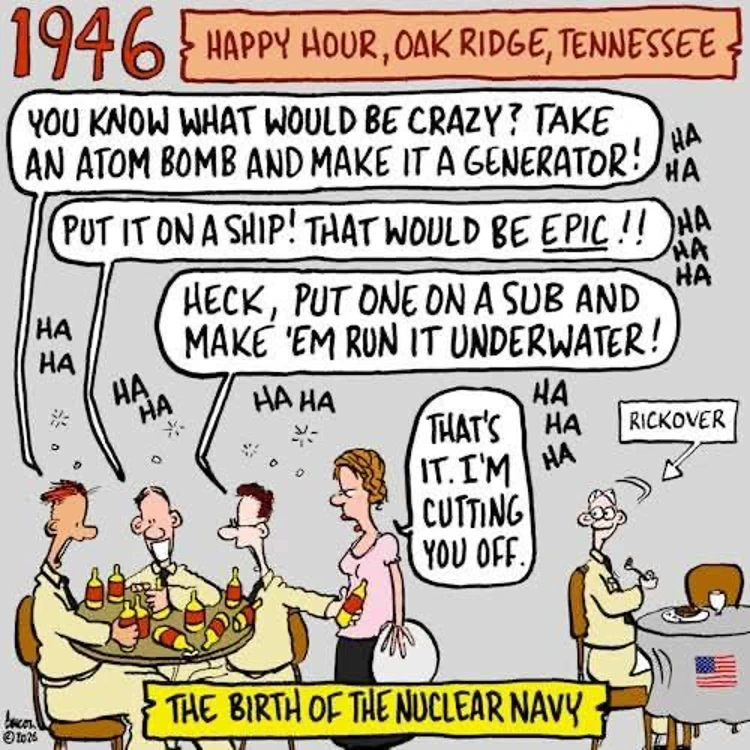
Do you have a huge, hairy, audacious vision for the future? Do you face massive pressure to slow down and wait for others to catch up? Learn from this example of one of the greatest military leaders in history, whose only command was briefly of a minesweeper in 1937.
This cartoon actually makes light of the fact that Admiral Hyman G. Rickover was the visionary who almost single-handedly pushed, prodded, manipulated and cajoled the Navy's engineering wing, congressional delegates and their staffs, and national political and business leaders to rally against very powerful Admirals resistant to change who wanted to shape the Navy of the future to conform to what had just won WWII. Admiral Rickover foresaw the lesson from the early Pacific War: The Navy suffered devastating losses because it was designed and shaped to fight the previous war instead of the future war. His vision was to create the first fully stealthy submarine that could generate its own oxygen and distill water from the sea, enabling it to remain submerged and undetected until its mission was complete. His vision was actually to replace fossil fuels with nuclear propulsion so the submarines and surface fleet could steam independently and quickly. to where needed. The ships would then be ready to fight immediately upon arriving at a hotspot rather than waiting for the supply chain to catch up—a problem that has plagued military forces for much of history. He also had the idea that if submarines could stay submerged and only come up near the surface to deliver weaponry (including ballistic missiles with nuclear bombs,) that could be a force multiplier and a deterrent to future world wars. His vision came true. He worked diligently and tirelessly from 1945 through the early 1950s until the USS Nautilus was finally launched. He faced so much resistance to putting nuclear propulsion on aircraft carriers that he devised a proof-of-concept test platform to prove that more than one nuclear reactor could be placed on the same ship. So he designed and built the USS Triton with two reactors and convinced President Eisenhower to authorize a secret mission to transit the globe submerged. The fanfare of the successful mission finally overcame resistance from the hidebound surface fleet Admirals who had been sabotaging his agenda and vision. The Triton had some utility as a radar picket because, unlike WWII picket destroyers, it could submerge if detected while quickly and unexpectedly transitioning to new locations. However, by circumnavigating the globe submerged along the same route as Magellan, it profoundly demonstrated what nuclear propulsion could do for the surface Navy. Soon after, the USS Enterprise began being designed with eight nuclear reactors, and all modern aircraft carriers have two reactors for redundancy. His career was rife with examples of his boldness, political stunts, and outright skullduggery to push the fleet into nuclear propulsion. In testifying before Congress one time, to alleviate the concern that nuclear reactors were unsafe, he drank a beaker of decontaminated reactor coolant water. He promised Congress that any officer serving on a nuclear-propelled naval ship would have to pass a personal interview with him before being accepted into the program. This legacy continues today, with his successors doing the exact same thing. I too, was interviewed by Adm. Rickover before being accepted into the nuclear propulsion officer training pipeline during my senior year of college in 1978. Before entering his non-descript and very humble office, we young midshipmen were thoroughly coached on what to do and not do when meeting 'the Admiral'. For several days before our final yes or no with him, we underwent difficult written tests and oral examinations by his staff. They reviewed every college course we had taken, comparing our grades received from each university in the country against how previous applicants with similar grades had performed during nuclear propulsion training. (It was extremely fine-tuned predictive hiring long before it became an HR buzzword.) The interview itself was brief—only two minutes—but memorable. I was overwhelmed afterward because it was nowhere close to what I expected. He quickly led me to a point where I slightly grinned at him and gave a somewhat sardonic answer to his last, somewhat ironic and illogical, question; followed by a curt "that's all" to my escort. Outside the door, I collapsed against the wall, turned to my escort, and said, "I just gave a flippant answer to the Admiral." He said, "That's OK, you're in." The Admiral was famous for detecting and exposing arrogance or hypocrisy during those brief interviews. They had coached us to be brutally honest, prepared to back up any declarative statement with facts, and to answer only the question asked with no elaboration or backstory. (which is a good summary of 'the Rickover way')
From the very beginning, operations of the US Navy nuclear propulsion plants set very high standards for safety, reliability and conducting ourselves in the 'Rickover way'. As these officers and enlisted personnel trained by this program retired or finished their active-duty obligation, his influence spread, dominating the civilian nuclear generation industry as well as many other industrial processes and sectors. All because one man had a strong vision and conviction that discipline and superior technology were the path to peace. You too can change the world (or the part of it you influence) by following his example.